
X60
Shipping in K1The edge AI core: 8-core coherent clusters at 2 GHz on TSMC 22 nm, about 35% lower power than same-class rivals. The first 8-core RISC-V AI CPU in volume.
>3.5 SPEC2006/GHz · 2 GHz @ 22 nm
K3 runs 30B-parameter models on device. K1 is the world's most popular RISC-V AI CPU.
| Key Stone K1 | Key Stone K3 | |
|---|---|---|
| CPU config | 8 × X60, up to 2.0 GHz | 8 × X100 + 8 × A100, up to 2.4 GHz |
| Peak integer compute | 50K DMIPS | 130K DMIPS · over 9.0 SPECint2006/GHz per core |
| AI compute | 2.0 TOPS fused in the CPU cores | 60 TOPS INT4 · BF16 / FP16 / FP8 / INT8 / INT4 |
| ISA profile | RVA22 · RVV 1.0 256-bit | RVA23 · RVV 1.0 1024-bit · Hypervisor + AIA + IOMMU |
| Process node | TSMC 22 nm | TSMC 12 nm |
| Memory | LPDDR4X 2400 MT/s · boards carry 8 to 16 GB | LPDDR5 6400 MT/s · boards carry 16 to 32 GB |
| Video codecs | Hardware VPU decode · 4K playback | Decode 4K120 · encode 4K60 |
| Target workloads | SBCs · robots · edge LLM terminals · NAS · industrial terminals | AI computers · embodied robots · personal and edge AI servers · LLM inference |
One core line spans every chip above. Each generation doubles the integer throughput per gigahertz.
The edge AI core: 8-core coherent clusters at 2 GHz on TSMC 22 nm, about 35% lower power than same-class rivals. The first 8-core RISC-V AI CPU in volume.
>3.5 SPEC2006/GHz · 2 GHz @ 22 nm

The first RISC-V processor core with full virtualization support: 12-stage, 4-wide out-of-order, RVV 1.0 with vector crypto, proven in mass production.
>9 SPECint2006/GHz · 2.5 GHz @ 12 nm

Optimized for AI inference: 14-stage, 6-wide out-of-order on TSMC 6 nm, with confidential computing, TSO, and coherent instruction cache. Not yet in a shipping kit.
>16 SPECint2006/GHz · 3.2 GHz @ 6 nm
The power half of the platform, built for the same boards.
Multi-channel power management chip: 6 COT bucks, 12 LDOs, MTP NVM, with UVLO, OCP, OVP, and thermal shutdown. Ships with K1 on MUSE Paper.
High-performance four-phase buck: 32 A sustained, 40 A peak, 91% peak efficiency, MTP-programmable timing, in a WLCSP 80-ball, 0.4 mm pitch package.
Licensed alongside the cores or already inside K3's virtualization and security blocks.
Two stacks, one runtime story: the silicon's capabilities exposed without bespoke kernel work.
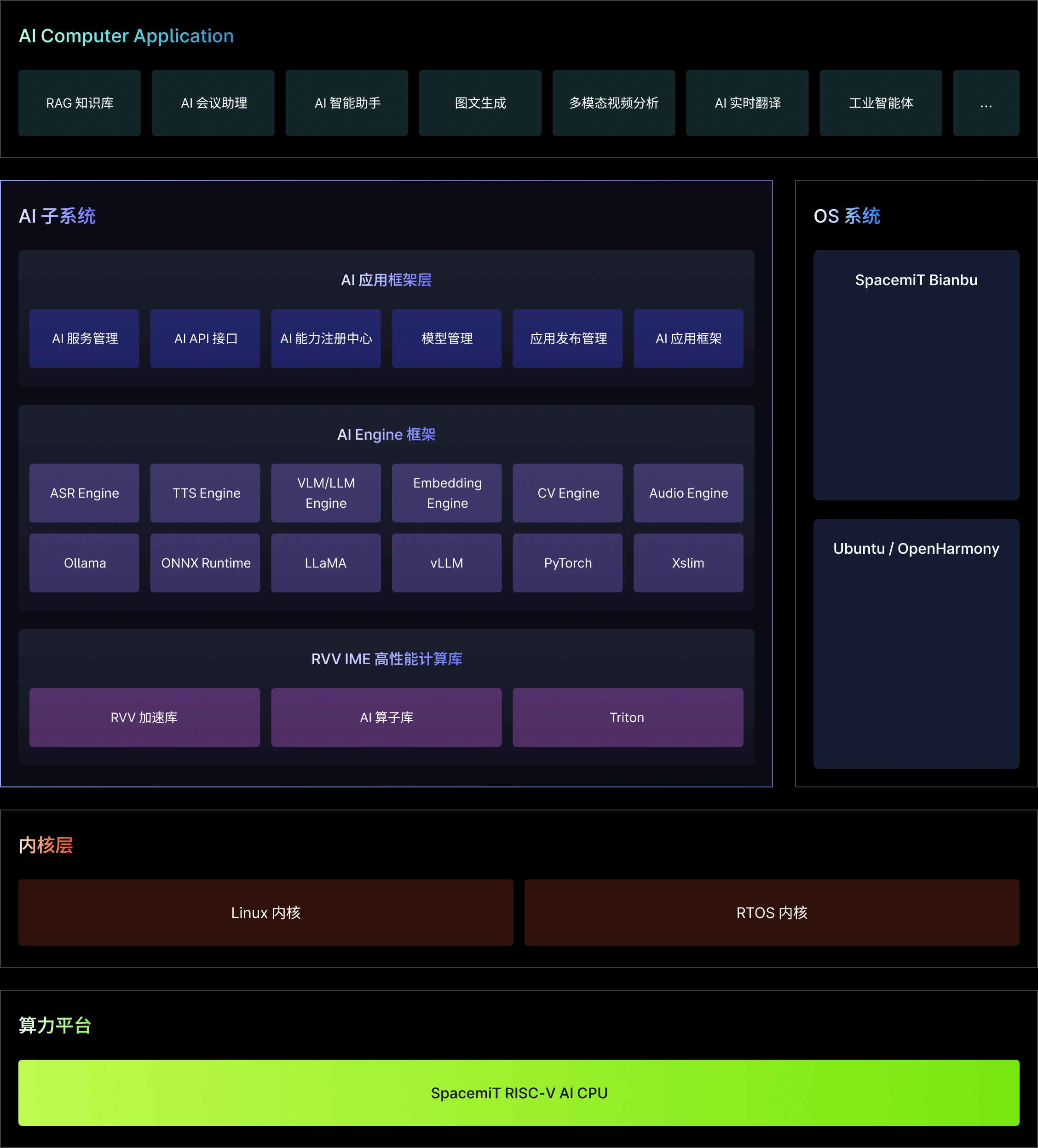
From a single board to a 48-chip cluster on one software stack.
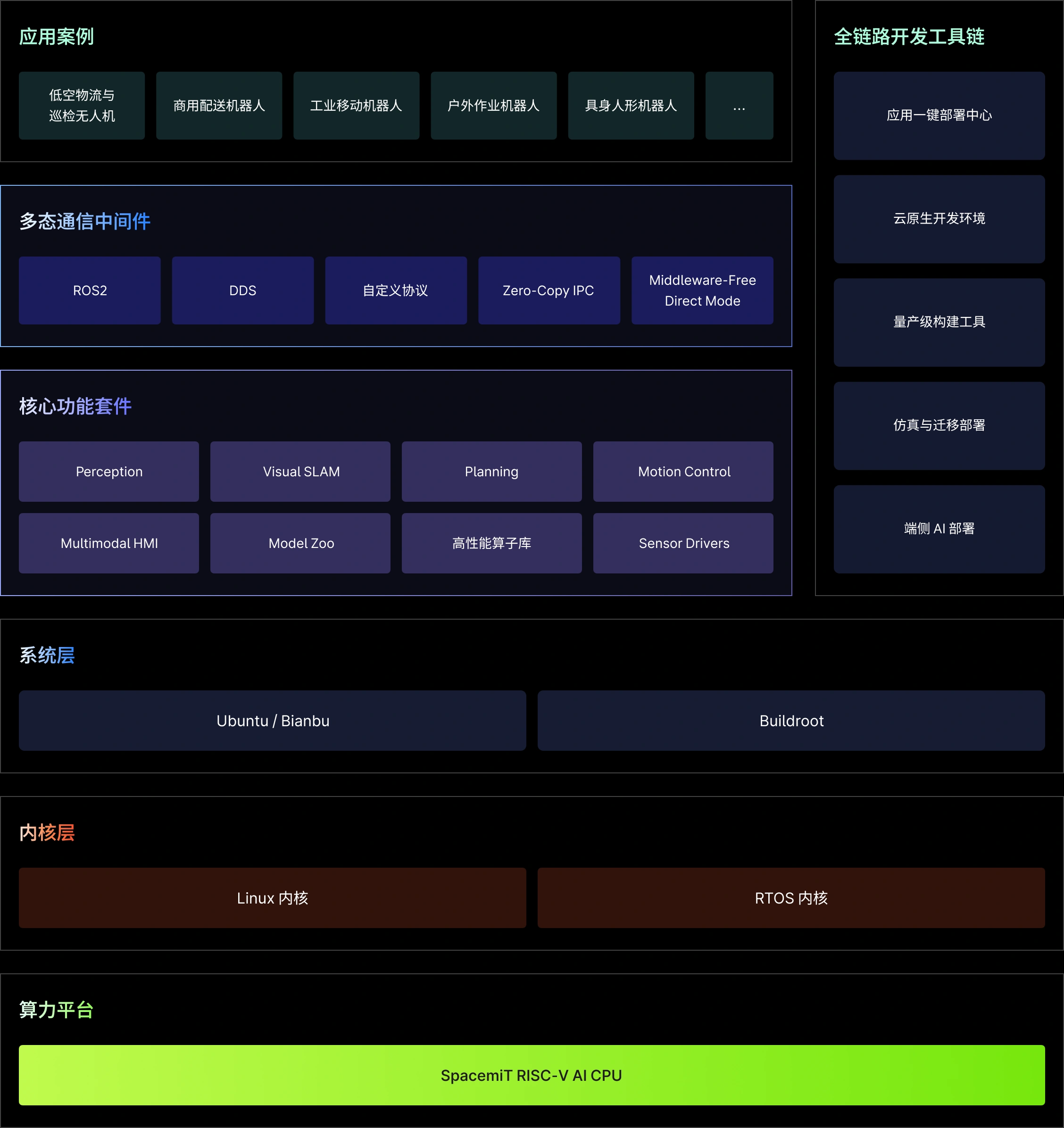
Perception to actuation in one flow, on the robot's own silicon.
Ten official kits carry these chips, from an 85 × 56 mm board to a 2U cluster.
See the boards